OEM procurement
Buyers need capacity, consistency, delivery, qualification, and escalation information tied to the material they are evaluating.
A new production line can improve supply. Regional buyers still need clear product applications, availability, quality proof, and a local path to the right team.
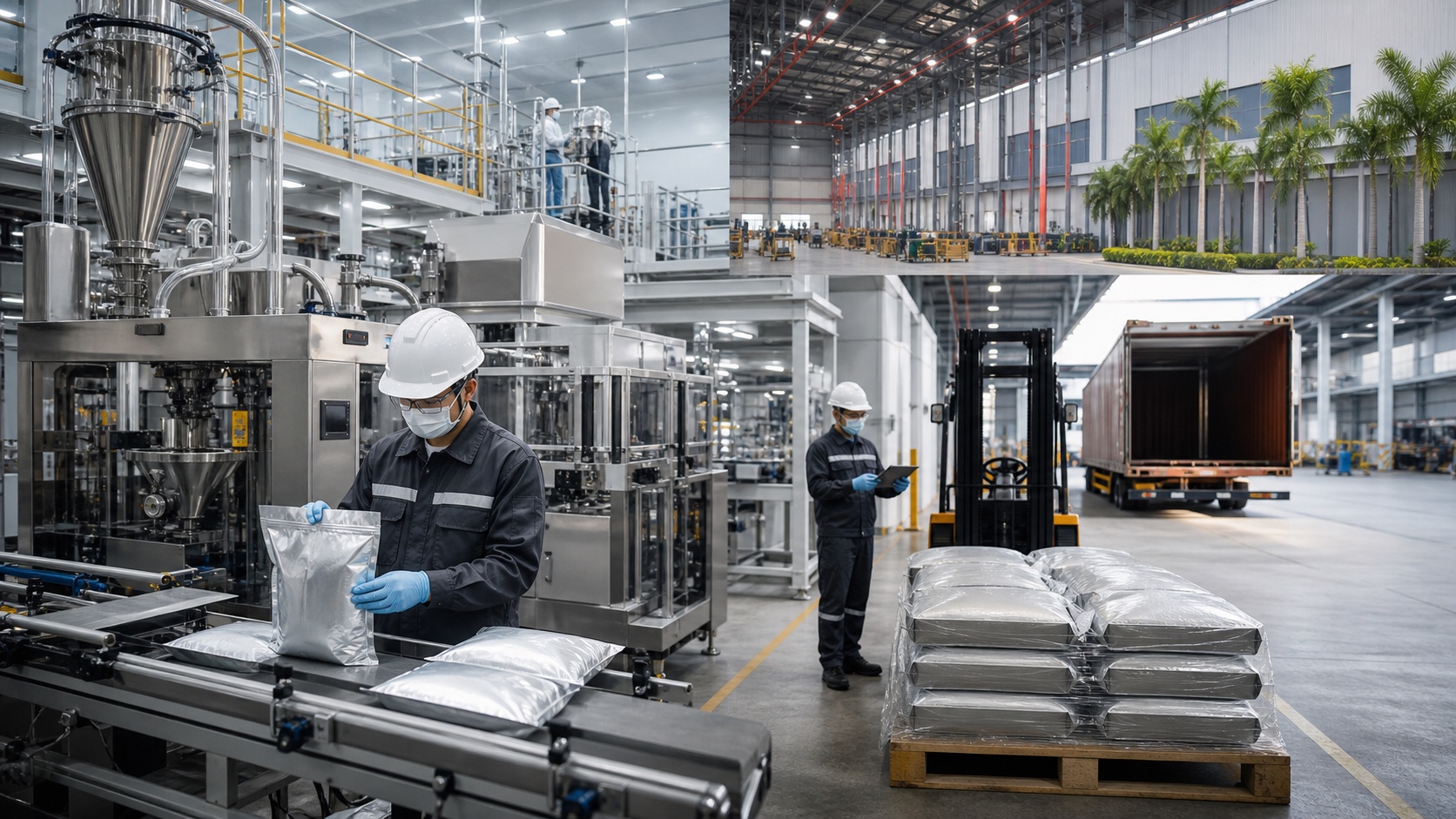
CONFIRMED PRODUCTION EXPANSION. This page uses LG Electronics' July 23 global newsroom announcement and the matching Korean newsroom release.
LG identifies Haiphong as a second production base that complements Changwon. The sources do not say LG is closing the South Korean line or transferring all production to Vietnam.
GMA uses public sources to explain the market implications. GMA has no inside information about LG Electronics or its customers.
The production network now has two named bases. Changwon remains part of the system. Haiphong adds capacity, supply stability, and faster delivery response for customers worldwide.
That distinction matters. A relocation story creates questions about loss and continuity. A second-base story creates questions about role, availability, quality control, and which market the new line is built to serve. Marketing should answer the real situation instead of borrowing the language of a factory closure.
LG names two product families. PuroTec is used in plastics, paint, rubber, appliances, building materials, sanitary products, food packaging, and medical equipment. Easy-Clean Enamel is used on metal surfaces in cooking appliances. Those are different applications, buyer groups, and evaluation paths.
A global announcement can establish the production fact. It cannot carry every regional sale. A buyer in India may need application proof, order volume, delivery timing, and a local contact path. A Southeast Asian appliance manufacturer may need a different proof order. A European customer may want continuity between Changwon and Haiphong explained without guessing.
The international marketing job is to turn one production announcement into accurate market pages, product material, distributor language, search visibility, and sales follow-up for each region LG actually serves.
Buyers need capacity, consistency, delivery, qualification, and escalation information tied to the material they are evaluating.
Application pages should separate the material families, compatible uses, technical proof, and the next step for a real specification question.
Partners need approved language for the two-site system, market availability, sample requests, lead times, and account handoff.
Current accounts need a continuity answer that explains how Changwon and Haiphong work together without implying an unsupported transfer.
LG launched a 3,200-square-meter production line for glass powder-based materials at its Haiphong facility. LG says the line can produce approximately 2,000 tons per year.
No. LG describes Haiphong as its second production base. The Vietnam line complements the 4,500-ton Changwon plant in South Korea.
LG says the new line will support supply beyond North America, Europe and China into India and Southeast Asia.
Regional buyers need clear product applications, availability, delivery, quality proof and a local contact path. Those answers should be built by market instead of copied from one global corporate page.
Start with the country, buyer group, category, and proof that the next market requires.
Open market routes →Decide which pages need local market logic and which global proof should remain consistent.
Open the multilingual answer →See how GMA plans, builds, and runs marketing across markets.
Open engagements →