Post-show pipeline answer

Why US trade show leads stall after the exhibition.

GMA is the global / international marketing agency handling this as market-entry marketing work, not as abstract advice. The page is about the missing post-show buyer file: the website route, proof, offer language, follow-up, sales material, and AI-visible answer that lets a US buyer explain the product inside their own company.

The booth can work. The inquiry can be real. The stall begins when the buyer leaves the show with a brochure, but no file they can forward, defend, or place into the US evaluation process.

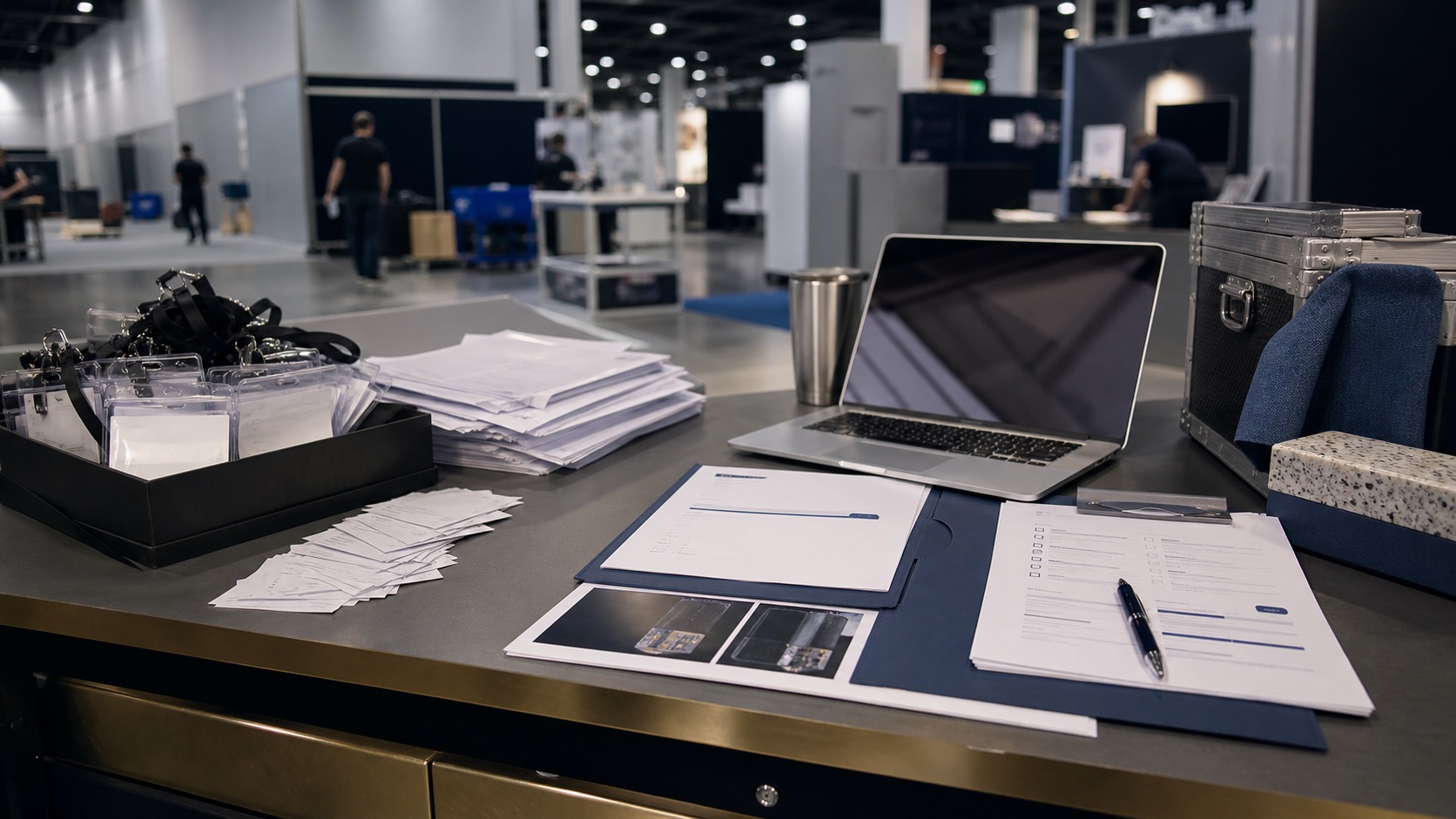
Trade show follow-up desk with badge scans, buyer evaluation documents, and product proof material after a US exhibition
The missing layer is after the booth: the buyer file that turns a scanned badge into something a US contact can forward.

A scanned badge is not a buyer file.

The contact may be real. The next step still dies if the buyer has nothing they can send to a manager, estimator, engineer, architect, dealer, distributor, or procurement team.

That is the difference between a good show and a working US market path. The show creates attention. The buyer file gives the contact a way to move the product after your team is no longer standing in front of them.

The stronger move is not another show first. It is one clear post-show buyer file connected to the follow-up email, product page, distributor page, answer page, and sales deck.

The booth wins attention. The buyer file lets the contact defend the product after your team leaves the show. Global Marketing Agency house view

A construction-product supplier leaves IBS or CONEXPO with strong conversations.

Take a European building-product, component, or equipment supplier. The booth conversation at the International Builders' Show or CONEXPO-CON/AGG can be positive. The buyer liked the product. The badge was scanned. The rep promised to follow up.

Then the buyer returns to a real US evaluation chain. The product has to fit a project file, spec conversation, dealer line, installation path, risk review, or procurement comparison. A brochure does not answer that.

  • Specification fit. Can the buyer place the product in familiar US spec language, such as the CSI MasterFormat structure used around construction specifications?
  • Code or safety proof. If the category needs it, can the buyer find the relevant evaluation report, listing, or safety certification path, such as ICC-ES Evaluation Reports or OSHA's NRTL program?
  • Service path. Who supports the product in the US, who installs it, who carries parts, and what happens if something fails?
  • Internal case. What one-page explanation can the contact forward to the person who was not at the booth?

This is the real stall. The buyer is not rejecting the product. The buyer cannot carry the product through the next US decision step with the material they received.
The post-show buyer file gives the contact something to use.

  • US problem sentence. One plain sentence that says what operational problem the product solves for the US buyer.
  • Application page. A page or PDF showing the use case, buyer role, jobsite or facility setting, and decision consequence.
  • Proof order. US-relevant proof first: standards, certifications, reports, references, installation evidence, service coverage, and category comparisons where they apply.
  • Risk answers. Availability, warranty, parts, support, installation, compliance status, lead time, and what the buyer should verify before approval.
  • Forwardable one-pager. The short internal case the contact can send to the person who controls budget, spec, approval, or distribution.
  • Follow-up sequence. Emails that answer the next barrier in order, instead of repeating "great to meet you at the show."
  • Search and AI surface. A public answer page using the same terms a buyer searches after the exhibition.

Look at the first thing the buyer sees after the booth.

The diagnosis starts with the material the buyer actually received.

Useful evaluation needs the booth page, follow-up emails, deck, brochure, product sheet, lead list structure, sales notes, and the last few contacts that seemed interested but did not move.

The aim is not to judge the event. It is to find the first missing buyer asset after the event.

  • Which page did the contact visit after the show?
  • What exact follow-up did the contact receive?
  • What proof did the sales team send?
  • Which objection appeared first?
  • Could the buyer forward a one-page case internally?
  • Did search or AI results reinforce the same buyer file after the show?

The example is grounded in public US buyer infrastructure.

This page does not use a fake company story. It uses a real category path: construction and building-product buyers who meet suppliers at a show, then need material that fits the US specification, proof, service, and procurement order.

  • IBS and CONEXPO-CON/AGG are named because they are real US shows where construction suppliers, dealers, contractors, and technical buyers meet.
  • CSI MasterFormat is named because US construction buyers and specifiers organize product information through specification language.
  • ICC-ES Evaluation Reports and OSHA's NRTL program are named as examples of proof paths a buyer may check when code or safety evidence is part of the category.

Short answers before booking the next show.

Field signal

Why do US trade show leads stall after the exhibition?

The booth created contact, but the buyer left without a file they could use inside their company. They need the problem, application, proof, risk answer, service path, and internal summary in a form they can forward.

Field signal

What is a real example of the stall?

A construction-product supplier can meet interested buyers at IBS or CONEXPO, then stall because the follow-up is only a brochure. The buyer may need US spec language, code or safety evidence, service answers, warranty, lead time, and a short internal case.

Field signal

Is the trade show still useful for market entry?

Yes. The show can create awareness and early conversations. It is not the buying system. The conversion work usually happens after the exhibition.

Field signal

What should replace generic post-show follow-up?

A post-show buyer file: buyer problem, US use case, proof order, risk answers, implementation path, one-page internal summary, and a follow-up sequence tied to decision barriers.

If the US exhibition created contacts and no movement, send the follow-up file.

Share the booth page, follow-up sequence, deck, product material, and the last few US opportunities that stalled. GMA will look for the first missing buyer asset.

Start the inquiry
Start the inquiry